
Coastline, interrupted
Tanja Bosch
New Media Room: 29.01.26 - 05.03.26
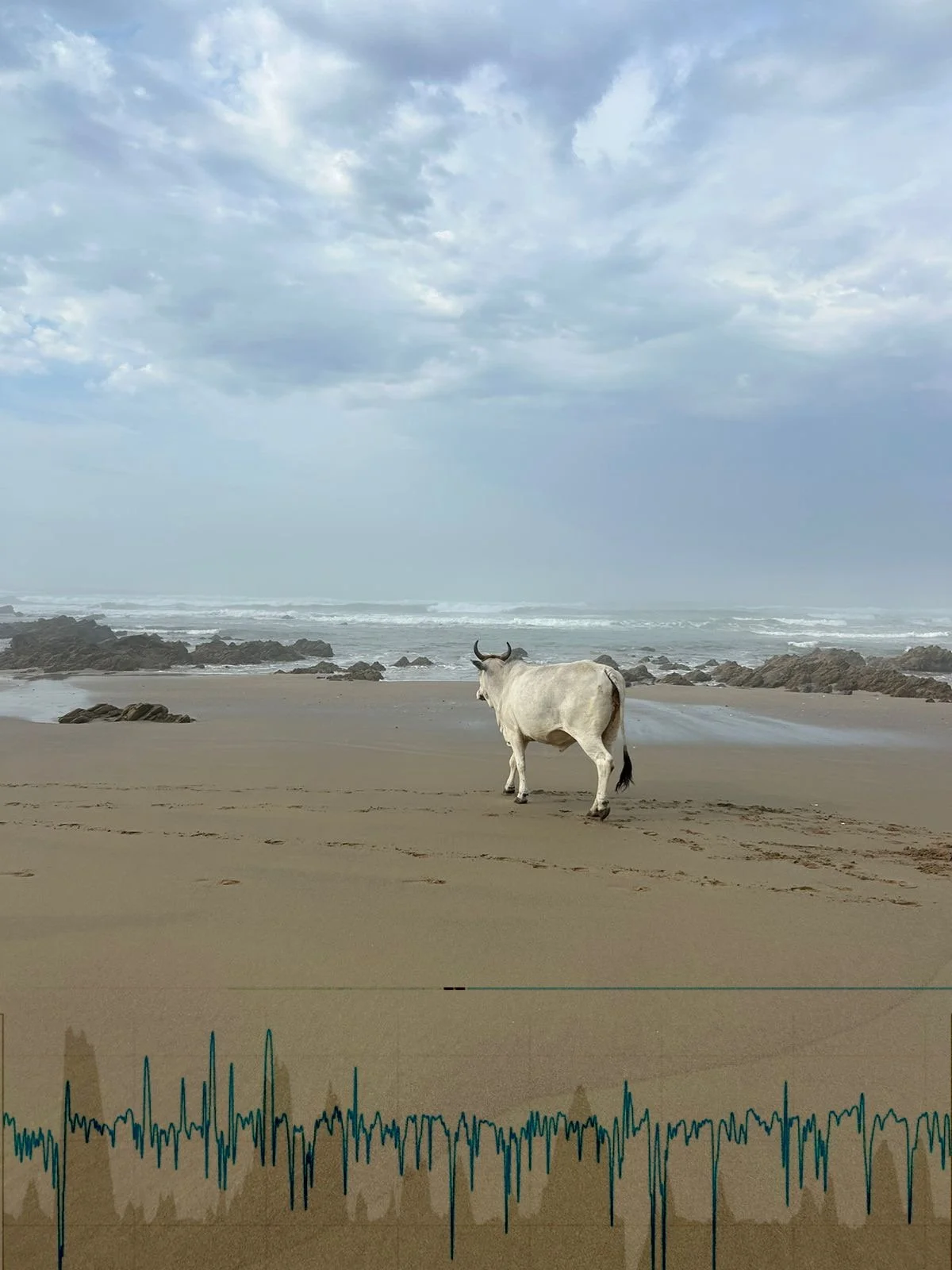
Coastline, interrupted brings film, photography, and walking-based research into conversation to explore how bodies, landscapes, and digital traces intersect along South Africa’s Eastern Cape Wild Coast. The project originates from a five-day hike undertaken not with artistic intention, but through the habitual logics of the quantified self: cellphone and GoPro footage, incidental video, GPX tracking, and the routine recording of terrain, distance, and movement. The installation explores what happens when data meant for measurement is revisited as material for sensing the coast’s social, political, and environmental entanglements.
The photographic prints function as a spatial threshold to the film, grounding the work in accumulation, categorisation, and relation rather than narrative sequence. The images are organised through four analytical lenses: landscape as baseline, people as relational data, animals as resident life, and buildings and houses as sediment. Landscape establishes the ground against which movement occurs. Human figures appear as temporary relations. Nonhuman life asserts continuity and dwelling. Built forms accumulate as material residue, registering the slow violence of colonial and extractive settlement along the coast.
Drawing on the method of media-walking (Iqani and Bosch 2025), the work approaches walking as a way of knowing place, one that reveals both its surface beauty and the layered histories that shape it. The coastline encountered here is not neutral. It is marked by extractive pastoral economies, uneven access, damaged infrastructure, and the long legacies of colonial and post-apartheid geographies. Moving through this terrain means repeatedly meeting boundaries: fences, gates, livestock, private holdings, community pathways, and the residues of labour and displacement. These interruptions become central to how the coast is lived, crossed, and contested.
The film foregrounds the tension between landscape and data. Fragments, glitches, GPX traces, and a brief recorded conversation expose the instability of perspective and the limits of capture. Here, the quantified self does not simply observe the coast; it distorts, fragments, and sometimes overwrites it. At the same time, the landscape pushes back: weather, terrain, and rhythm interrupt the data, disrupting the promise of seamless tracking.
Across the installation, the researcher’s body appears not as an outside observer but as part of the field, entwined with both land and metric. Coastal, interrupted offers no single perspective. Instead, it invites viewers into the friction between movement and measurement, landscape and data. The installation suggests that walking the coast reveals as much about the limits of digital capture as it does about the coast itself, and that even the most ordinary forms of documentation carry a politics of seeing.
Tanja Bosch is a B-rated scholar and National Research Foundation Chair in Digital Media Sociology at the University of Cape Town, where she works on digital citizenship, environmental communication, and critical, decolonial methodologies for studying platformed life. She is author, among others, of Social Media and Everyday Life in South Africa (Routledge) and has published widely on platformed publics, sonic citizenship, and political communication. Her research examines how digital infrastructures shape everyday experience, and how bodies, technologies, and environments become entangled through practices such as walking, running, and self-tracking. A key strand of her work focuses on decolonial approaches to media studies, emphasising situated knowledge, the politics of representation, and alternative modes of knowing. She is a hiker and trail-runner, and her creative practice explores how data, movement, and ordinary technologies shape how we perceive and inhabit space and place. Coastal, interrupted is her first major solo installation.
