
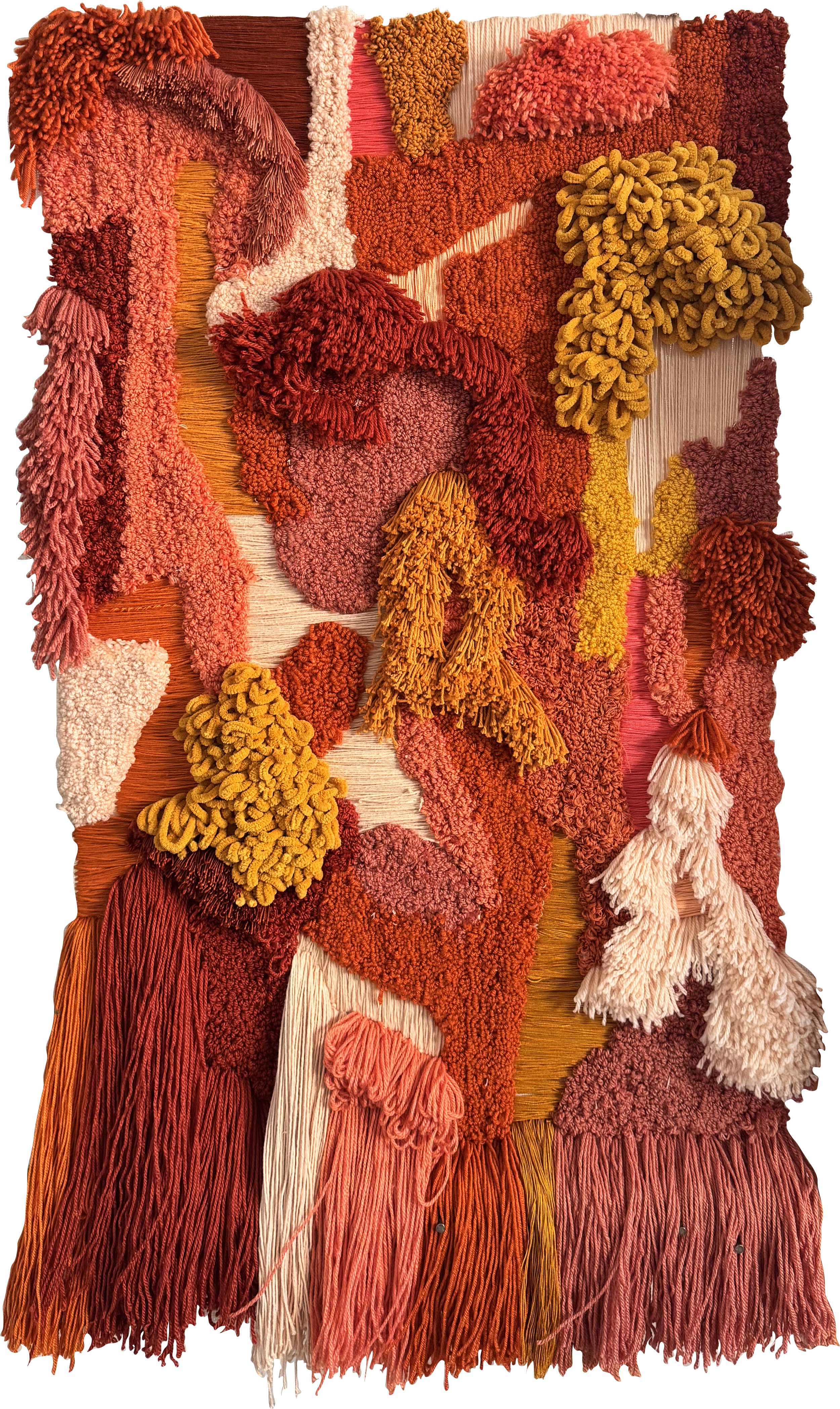
Lebogang Mbewe, Uzung’ a wothi, uyashisa ungawu lokothi, 2025
To Whom It May Concern
A solo exhibition by Lebogang Mbewe
Front Gallery: 30.04.26 - 11.06.26
To Whom It May Concern is an intimate letter stitched into public space — a call, a confrontation, and a gesture toward repair. The phrase, often used when the recipient is unknown or withheld, becomes a site of tension: a letter addressed to systems, histories, ancestors, and futures that may or may not respond. The exhibition unfolds as an epistolary landscape in which tapestries operate as textile-based letters and surfaces that hold memory, fracture, and repair. It explores how histories, shaped by displacement, extraction, and systemic injustice, continue to inhabit bodies, psyches, landscapes, and everyday spaces. It holds space for confrontation and care, asking not only what needs to be said, but what it means to listen, to respond, and to take responsibility.
The exhibition opens with Not Everything That Is White Is Pure, a provocation that unsettles assumptions of innocence,neutrality, superiority, and order, implicating both material and ideological constructions of colonial modernity. The act of address is already unstable, shaped by histories of misrecognition and refusal.
In Bantu Blues, history and identity, in relation to lived experience, are held in tension. The title draws on the imposed taxonomy of “Bantu”: a term shaped by colonial and apartheid systems of classification, while “blues” evokes both musical lineage and a register of mourning, endurance, and expression. Through stitching, the work reclaims this weight, dislodging it from administrative violence and re-situating it within embodied memory. Reparation begins here as an act of re-inscription.
In Uzung’ a wothi, uyashisa ungawu lokothi, tenderness reaches a limit and begins to fray. What emerges is not its opposite, but its escalation. Care sharpened into vigilance, into alarm.
The work gestures toward a firestorm. It sits within a landscape marked not only by inequality, but by ruination: infrastructures strained, promises exhausted, and the slow violence of abandonment accumulating over time. It marks this condition of imminence. It signals a threshold at which accumulated pressure can no longer be contained, where what has been suppressed begins to surface with force. The work does not predict rupture so much as it recognises that it is already forming, felt in the tensions between policy and lived reality, between the promise of inclusion and the persistence of structural violence. Here, reparation is no longer a distant horizon or institutional promise, but something urgent, unstable, and contested.
This tension comes to a head in Return to Sender, where the direction of address is interrupted and reversed. Drawing on the bureaucratic language of failed delivery, the work engages the condition of misaddress, of being named incorrectly, received partially, or not received at all. What is returned is not simply a message, but a history. Violence, projection, and imposed meaning are redirected toward their origin, unsettling the assumption that the burden of repair lies with those most affected. Reparation here includes refusal, the right to set boundaries, and the right to reject what cannot be carried.
The exhibition closes with Incwadi Encane: Take Care. The shift in language marks a movement inward, from formal address to something held and intimate. What begins as distance resolves into proximity, yet this is not a gentle ending. It is both a closing and a charge — an insistence on responsibility, on mending, and on sustained care.
Across the exhibition, the tapestries function as soft archives, carrying what exceeds institutional record. They hold what has been omitted, displaced, or denied, not as fixed documents but as tactile and embodied traces fragmented, affective, and unresolved. In contrast to the rigid impositions of colonial and modernist spatial systems, these works propose a different spatial ethic: one that seeks to hold rather than dominate.
Rooted in Black feminist and decolonial lineages, this exhibition positions tenderness as a political stance. It resists the demand to harden in response to violence and instead insists on care, connection, and accountability. Reparation emerges not as restoration, but as iterative, incomplete, and sustained.
Thread, within this body of work, operates as a line of relation tracing connections between past and present, absence and presence, self and other. Informed by African textile traditions, including forms of coded communication, the exhibition foregrounds making as a form of knowledge production: embodied, relational, and resistant to erasure.
This exhibition does not assume a distant viewer. It situates you within the address — implicated in the histories it holds, and responsible for the futures it gestures toward.
