
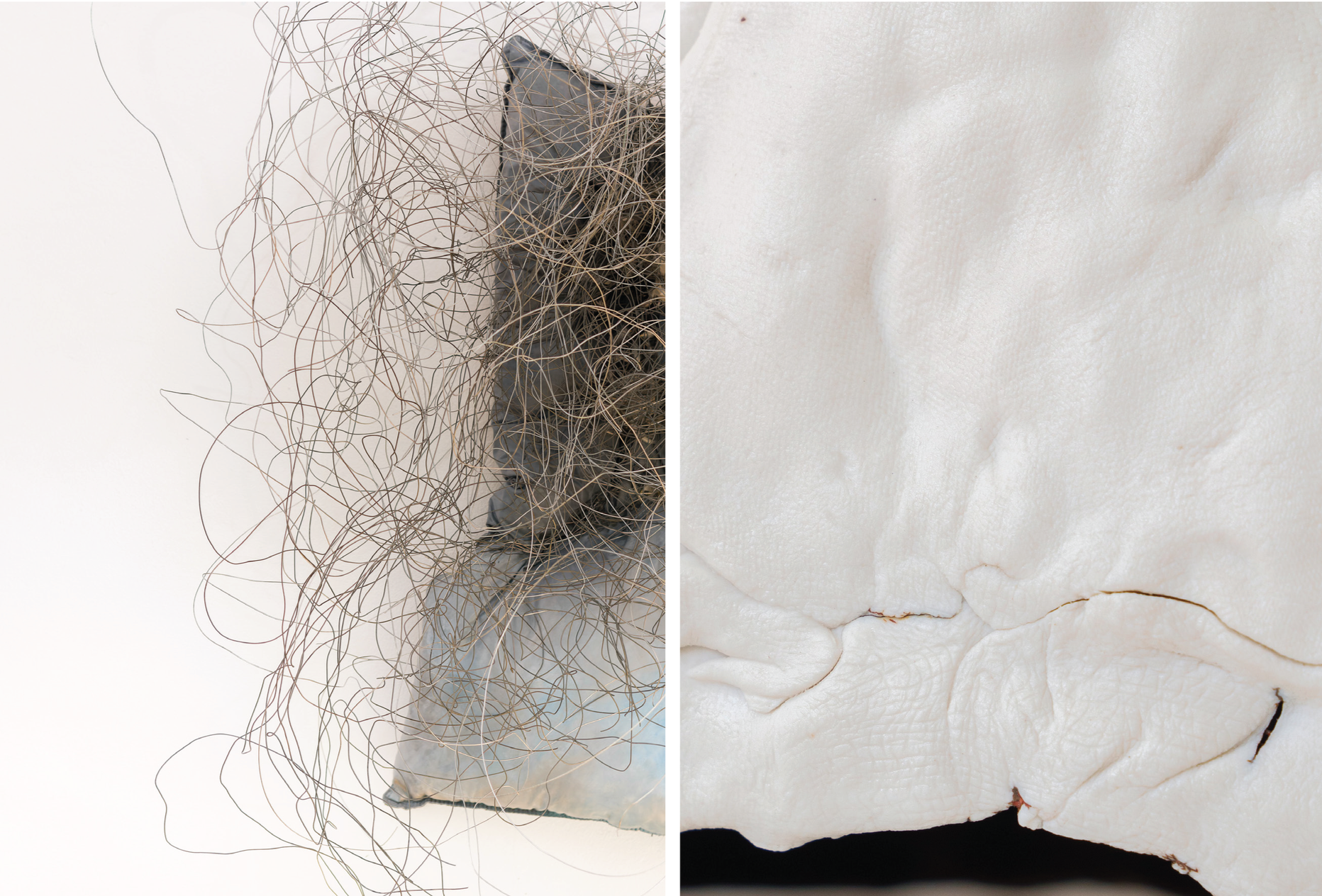
Left: Carola Friess, Vain Struggle, 2021 - 2025 (detail) | Right: Kerry Lee Chambers, Umbilicus (weight of my head), 2024 (detail)
Articulated seams
by Carola Friess & Kerry Lee Chambers
Main Gallery: 30.04.26 - 11.06.26
Syntactically speaking, seams are the simplest of conjunctions, holding two or more parts in relation: this and that provisionally arranged, pressed into proximity. An offcut of wire and discarded wax. Sculptures and works on paper. Carola Friess and Kerry Lee Chambers.
In Middle English, seam referred not only to a stitched edge, but to a gash or a scar, denoting those places where things both merge and are most likely to come apart, or where, having come apart, such things – be they flesh or fabric – are mended. Attesting to the word’s twinned meanings, wounds and veils are guiding motifs in these two artists’ works: those of the operating theatre in Friess’s, and those of Catholic iconography in Chambers’s. Surgery and Christianity reveal unexpected resonances, being predicated on the same promise: healing through rupture – from the scalpel’s incision to the crucifixion. The body is implicit in Friess and Chambers’s practices, however abstracted, disguised beneath surgical drapes or oblique symbolism, framed and fragmented, but above all, transfigured. Containment and spillage, concealment and revelation, a confusion of boundaries, of interior and exterior – these are among their shared preoccupations.
Friess and Chambers approach their thematic enquiries with a tactile materiality and intuitive engagement with the grammar of otherwise overlooked things, from found objects to studio flotsam – things ‘jettisoned’ in Friess’s words, or ‘fallen’ in Chambers’s. Both artists are attentive to moments of contact between unlike parts, to the seams of touch that exist between one thing and another, and the interdependency of difference such encounters might suggest. Both insist on a sense of temporary pause; each composition might well be differently arranged.
In the months preceding this exhibition, the artists traced their restless dialogue in a box of odds and ends, which travelled between them via post. The resulting objects bring to mind a game of exquisite corpse: a whole imperfectly composed of disparate parts. Returned from obscurity, each retains a history of use (cracked hand soap, stained scrim, worn brush), but is otherwise given without provenance. Together, these accumulated, collaborative studies offer another seamline: a thread of conversation, the stitches of exchange.
For all the parallels between their practices, in sensibility, they cleave. In Friess’s assemblages, her vocation as a surgical nurse is expressed in the somatic qualities of her compositions. Hers is a largely associative encounter with material, punctuated by more direct allusions: medical gloves, drip bags, steel plinths. Both artists cast objects; Friess also encases them – the encaustic quality of her work evoking organic and synthetic seepage. ‘What is body and what is prosthesis?’ Friess asks, to which Chambers replies in echo, ‘What is material and what is tool?’ Where Friess’s assemblages have a certain muscularity, Chambers’s sculptures find a fragility of medium and form. Where Friess figures presence, Chambers describes absence, casting negative spaces that allude to the ambiguity of wound-womb imagery in Medieval mysticism – every void made a vessel of meaning. Her material trinity of porcelain, plaster and paper clay lends these ambivalent relics an elegiac lightness.
As for their shared engagement with drawing, Friess takes as subject the Baroque theatricality of surgical sheets, which serve not only to protect the patient but the psyches of those who attend them, isolating the wound as an abstraction. The coincidence of her controlled lines and fluid drips and spills gestures to the mutuality of surgery’s precision and the body’s excesses. Chambers pursues less figurative ends in diverse mediums, from silverpoint traceries to painterly gestures transcribed in pigmented rabbit-skin glue. Made with rainwater and ink, her marbled paper panels register precise moments of touch between surface and substrate, each image transposed with alchemical immediacy. As contact prints of a kind, they invoke the apocryphal transfer of Christ’s likeness on both Veronica’s veil and his funeral shroud, if only obscurely.
Cadere, from the Latin, might serve well in thinking of Friess and Chambers’s paired practices, meaning to fall as under the weight of gravity, but also mortality and even morality, and from which English gleaned so many words, among them cadaver, cascade, chance, and cadence. Of these, look to the last, the notes on which a musical or spoken phrase comes to rest. In speaking to their work, the artists suggest that they share a syntax expressed with different intonations, their respective inflections producing divergent meanings within the same sentence, which pivots on that simplest of conjunctions.
And? And the seam at once traces the repair and recalls or pre-empts a rupture. And? And it is fragile preservation and record of past process. And? And it is a gesture of renewal, not a claim to resolution. And?
Exhibition Text by Lucienne Bestall
