
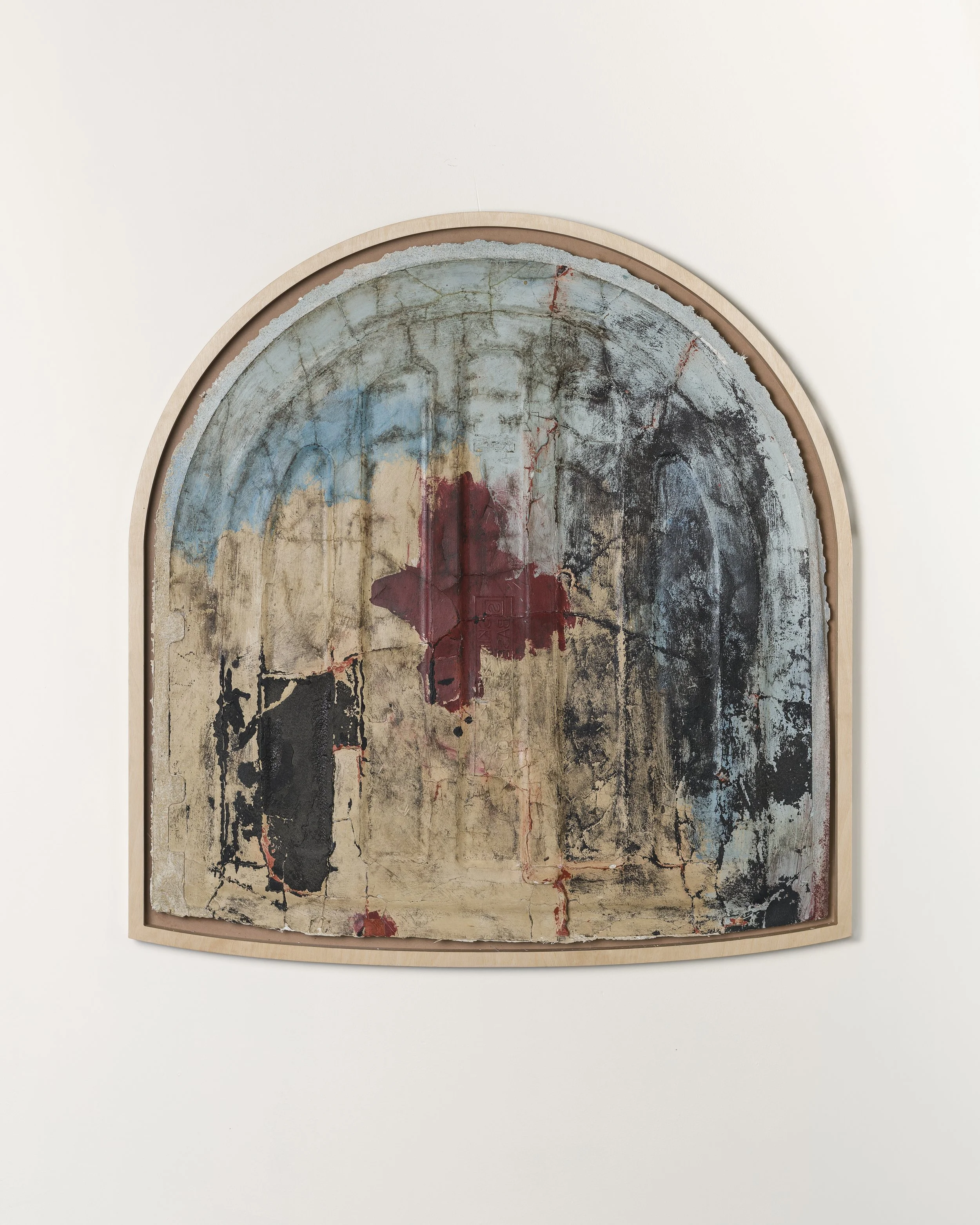
Kirsty Tinkler, Cleansing flame, 2025
Sacred Debris
A solo exhibition by Kirsty Tinkler
Front Gallery: 12.03.26 - 23.04.26
“In conceiving this exhibition, I was guided by the room itself, producing a body of work that functions as an installation as much as independent pieces. The square proportions of the space, the wooden roof and flooring, and the grand windows draw you into a different world, an intimate interior from another time. I found myself thinking of the room as an inner sanctum, a quiet place of contemplation. After discovering a discarded industrial rubber fragment in late 2025, whose arched form was suggestive of classical architecture, the idea of repetitively casting this fragment to evoke the rhythm of a cloister began to take shape.
The making of these works is driven by immediacy and, for me, a degree of risk. Each piece is constructed in reverse, as the surface is created and then built up from behind. Mixing pigment directly into the plaster, I must work quickly before each colour sets. Once reinforced with fibreglass, the work is revealed by peeling away the mould. Over time, the mould began to deteriorate, requiring conservation between castings. I began blocking deep cracks with terracotta clay; these patched seams then became integral to the finished works. The entire process involves an acceptance of uncertainty, allowing the outcome to remain partly unknown. As a result, the works feel alive to me, as though they are, in part, generating themselves.
As the eight wall works defining this mirror-like, cloistered space developed, they began to suggest movement and passage. I found myself thinking about the journey described by Dante’s 14th-century epic poem, The Divine Comedy. The panels offer abstract impressions of Dante’s path: the descent into Inferno, the ascent of Purgatorio, and the eventual arrival in Paradiso. This progression unfolds through shifts in colour and mood around the room. Engaging with the poem became, for me, a kind of mystical journey that revealed the medieval mind and a lost sense of religious mysticism, alongside a moral framework that still feels resonant.”
In Proud Partnership
This exhibition was made possible thanks to the support by the National Arts Council.
